

Rundown & Parabolic Screens
What are they?
Rundown screens, parabolic screens or sieve bends are mostly non-mechanical, non-compaction, and generally, a non-moving parts unit for separating solids from liquid, dewatering, or reducing volume.
They can be used in many applications and industries as a standalone static or mobile unit, built into a channel or waterway, and numerous units can be seamlessly coupled together or integrated into a process line.
Quick Page Links
SMG Industries
Rundown Screen Equipment
For most requirements.


More information
How they work
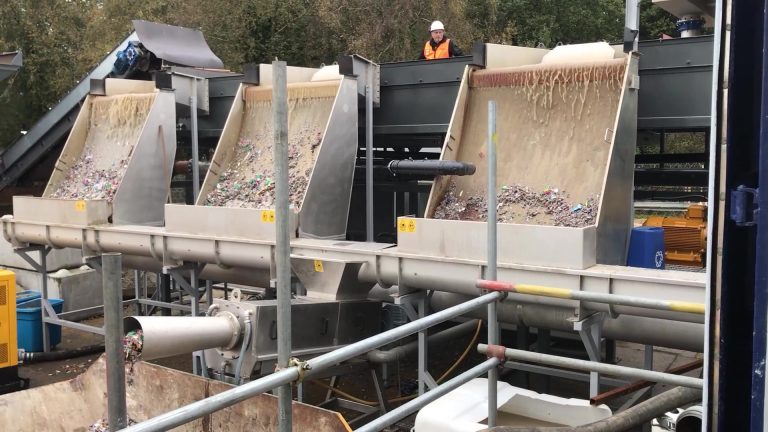
They work by running a pumpable suspended solid-laden slurry down an angled sieve screen, liquid and a portion of the smaller suspended solid particles pass through the screen and fall into the liquid element storage vessel or channel, leaving the larger solids along with any hung-up liquid on the surface.
As these solids build up and increase in weight, they work their way down the screen that eventually drop off the end chute into the dry element storage vessel/channel, producing a non-stackable product that needs contained storage.
Low maintenance
Due to our rundown screens’ simple concept, the units are an extremely cost-effective piece of equipment that is virtually maintenance-free and is made completely from stainless steel and can be used for corrosive, difficult, and high-temperature slurries.
They can be sited outside with the only limitation of shading from sunlight for certain applications to eliminate the solids on the screens surface from drying out, to overcome this and to keep the screen clean, units can be supplied with covers or doors and with options for automated or manual washing systems.
See Filtration for products to enable the washing water to be recycled.
SMG Industries
High throughputs
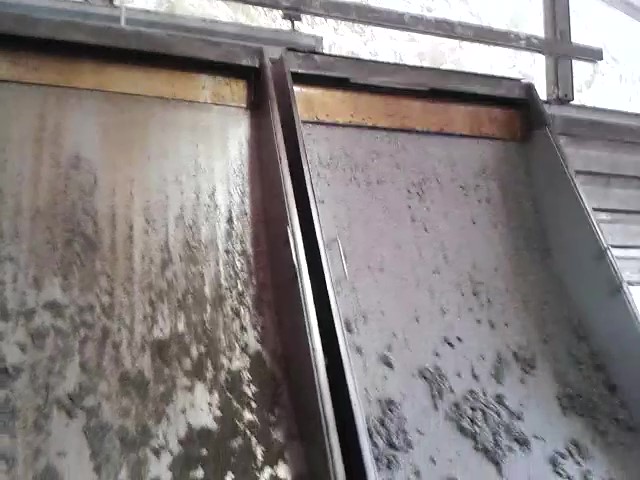
Rundown screens are easily scalable and can cater to most installation sizes, from small free-standing units to extensive, high-throughput applications.
High throughputs are made possible by the incoming slurry/sludge product being exposed to a large sieve screen surface area.
Initial Phase in a Two-Stage Process
The absence of mechanical force leads to fewer particles smaller than the sieve gap size passing through the sieve screen with the liquid. Instead, they stay with the dry element on the screen surface.
No mechanical force advantages, coupled with high throughputs, position this equipment as an optimal initial-stage process for effectively extracting most of the liquid before undergoing a compaction process. The process quality remains uncompromised, with some applications even experiencing enhancements.
SMG offers two options for the second-stage compaction process: the Screw Press or our integrated Compaction Module. The latter provides a cost-effective solution to improve liquid removal from the dry element.
Attention to Detail
Optimum design

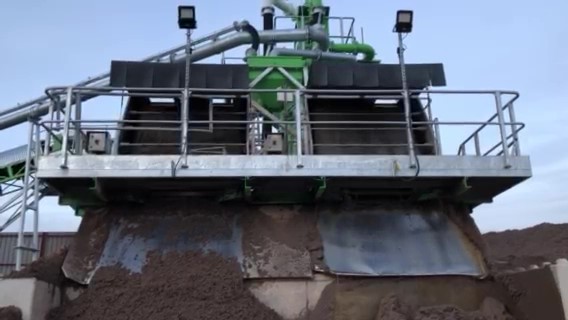
A welded 10° tilted wedge wire sieve screen that is mounted at an angle with a concaved curve, being almost vertical (90°) at the top/start and curves through to end up at around 45 degrees at the bottom/end. This design produces the best possible efficiency for these non-compaction separation units, as this 10° wedge wire tilt of each wire strand produces numerous small ledges that force more separated liquid to pass through the screen which increases the dry matter of the separated solids element. For more details visit Wedge Wire:
The concaved curve sieve screen profile, compared to flat versions, significantly increases the gap size (over doubles) on the non-working (underside of the screen) without affecting the gap on the working top surface that enables the separated liquid to pass through the screen more freely, considerably reducing any potential clogging/blinding issues, enabling the use of sieve screens with smaller gap sizes.
Being around 90° at the top/start where the slurry falls at high speed onto the sieve screen, a large proportion of the liquid immediately passes through the screen leaving wet solids on the surface to continue the fall down the screen. As the screen starts to curve to a more of a horizontal angle, the solids build up, increase in weight, and the fall starts to become a push. This push creates a squeeze that continues to remove more and more liquid as the solid mass moves down the screen to eventually drop off the end.
Options
Two versions

Static rundowns are the widely known, totally non-moving parts unit. For more details visit Static Rundowns

Vibrating rundowns enables the sieve screen to vibrate, adding to the efficiency of the simple rundown method that not only increases the solids removed from the liquid (as smaller solid particles are retained in the dry element) and raises its dry matter (DM) but also increasing the throughput. Although the sieve screen does vibrate, it is a virtually non-moving part, low maintenance unit.
For more details visit Vibrating Rundowns
Limitations of Rundown Screens
As rundowns are a non-compaction separation method that simply relies on gravity, and in some cases agitation, to separate the solids from the liquids, there are certain limitations:
- Using fine sieve screens with a small gap size; risk of screen blocking issues.
- The solids in the slurry need to be non-greasy/sticky and in suspension.
- The wetness of the dry element that is non-stackable – needs contained storage:
Coagulating the slurry before passing over the rundown screen enables significantly more small solids to be removed from the liquid but can add ongoing cost to the separation process.
For more details, visit coagulation, or another separation or filtration methods could be considered.


SMG Industries
Let's chat
Phone: +44 (0) 330 229 0193
Email: info@smg-industries.com
MON-FRI 09:00 - 19:00 (GMT), SAT-SUN 10:00 - 14:00 (GMT)
Contact an expert